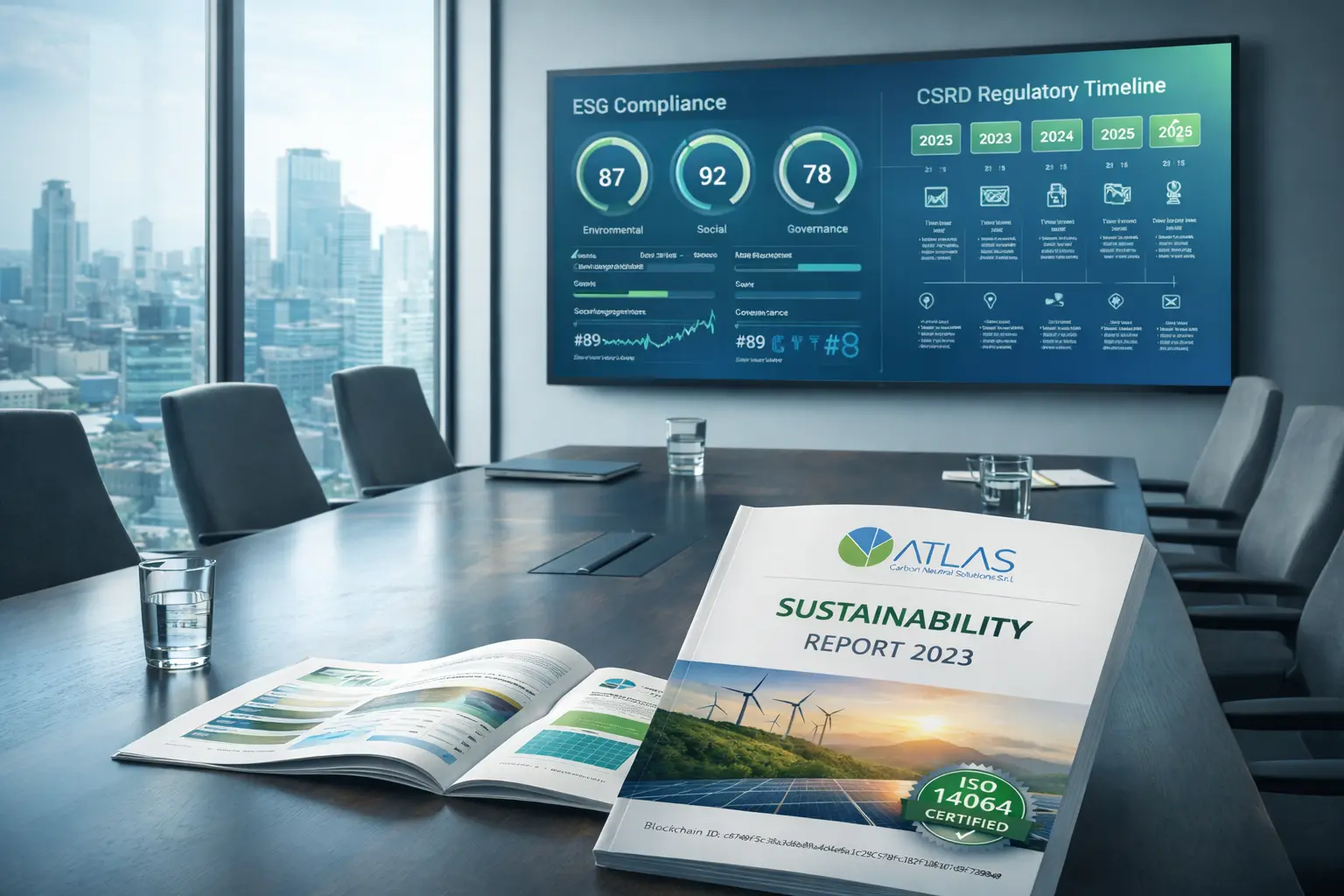
Your Sustainability Report. Certified, Blockchain-Verified, Audit-Ready.
Since January 11, 2026, EU banks are legally required to assess your ESG profile as a factor in credit decisions. 35% of eurozone banks have already tightened lending conditions for high-emitting companies with no transition plan. Atlas transforms your operational data into a Sustainability Report, anchored on blockchain and auditor-ready. Not a declaration: tangible proof.
Self-declared ESG reports no longer satisfy banks, investors, or large corporate buyers.
EU banks must now integrate ESG risk into every credit assessment under EBA guidelines. Your Tier 1 customers need your Scope 3Indirect emissions generated throughout the entire supply chain, from purchased materials production to product disposal. emissions data to meet their own CSRDCorporate Sustainability Reporting Directive: the EU directive making sustainability reporting mandatory for thousands of companies. obligations. And supply chain Scope 3Indirect emissions generated throughout the entire supply chain, from purchased materials production to product disposal. emissions represent 92% of disclosed European corporate emissions: your data gap is their compliance problem.
The Atlas method
- We collect your ESG data following ESRSEuropean Sustainability Reporting Standards: the technical European standards dictating how to compile ESG reports. requirements (or VSME for SMEs), structured and granular as required by EBA 2026
- We calculate Scope 1, 2 and 3Direct emissions (plants/vehicles), indirect emissions from purchased energy, and indirect emissions from the supply chain. emissions using recognised emission factor databases, never estimates
- We anchor every data point on Base ChainLayer 2 blockchain developed by Coinbase, with security guaranteed by Ethereum and near-zero transaction costs. (L2Protocols built on top of a main blockchain to increase speed and reduce transaction costs.) with SHA-256 hash, immutable and publicly verifiable
- We deliver a report verifiable by a sustainability auditor and ready for banks and stakeholders
What you get
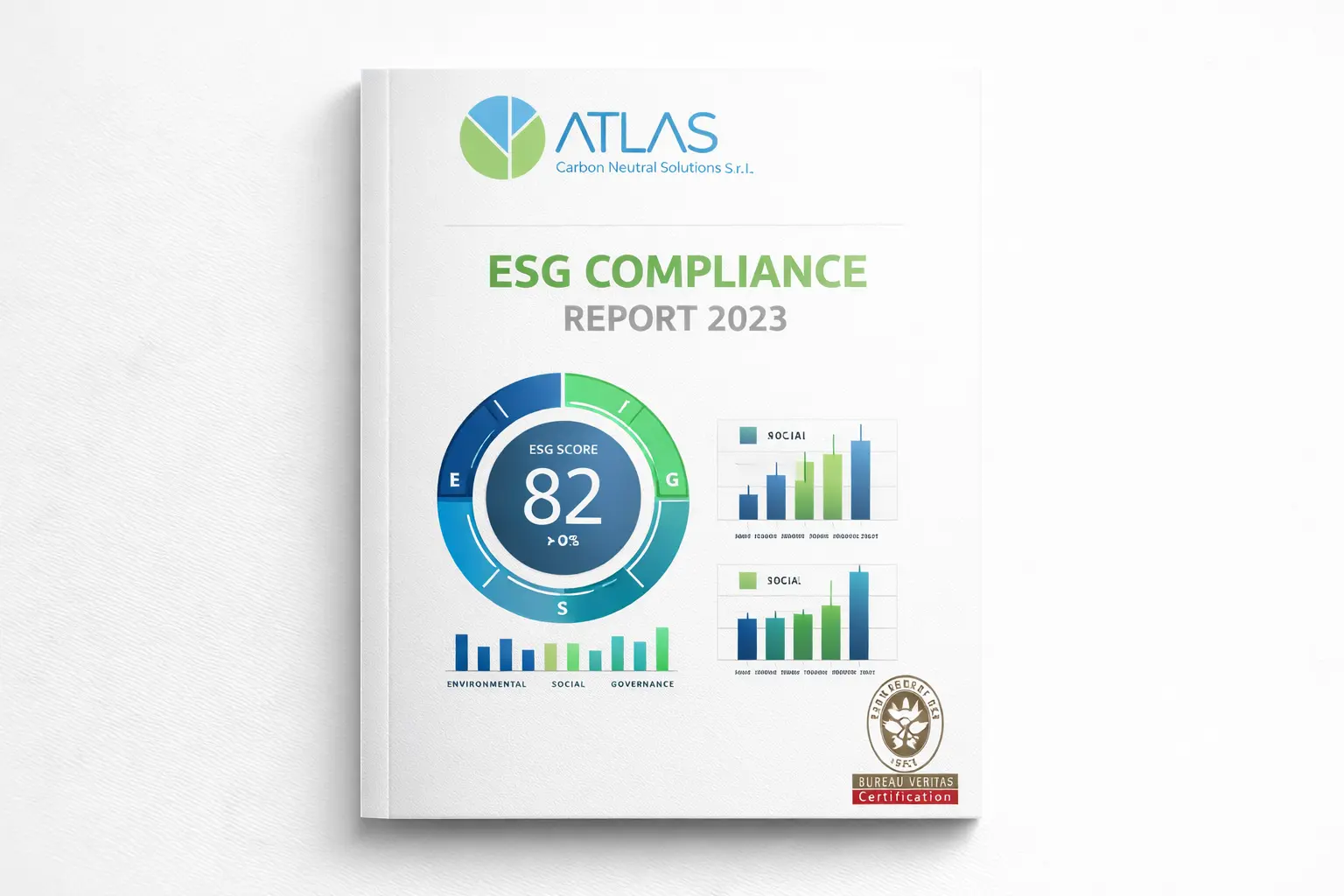
Certified sustainability report
A VSME or ESRSEuropean Sustainability Reporting Standards: the technical European standards dictating how to compile ESG reports.-aligned document with double materialityThe principle requiring assessment of both the company's impact on the environment and the environment's impact on the company. assessment, environmental, social and governance KPIsKey Performance Indicator: quantitative metrics for measuring and monitoring business performance., and attestation from an accredited third-party auditor. Accepted by banks, investors, and corporate procurement teams across the EU.
ESG rating with European benchmark
Your ESG positioning against comparable European SMEs in your sector. Critical gap identification and prioritised improvement roadmap. The latest CRIF 2025 report reveals that firms with high ESG scores have a 25% lower default rate.
Blockchain-verified certificate
Every data point in your report is anchored on Base ChainLayer 2 blockchain developed by Coinbase, with security guaranteed by Ethereum and near-zero transaction costs. with SHA-256 hash. Any bank, customer or auditor can verify the authenticity and immutability of your data in real time via atlascarbonneutral.com/verify. Cryptographic proof that eliminates greenwashing concerns before the audit even begins.
ESRS Framework: the three pillars
European Sustainability Reporting Standards are organised across three dimensions.
Environment (E)
- E1Climate change
- E2Pollution
- E3Water and marine resources
- E4Biodiversity and ecosystems
- E5Resource use and circular economy
Social (S)
- S1Own workforce
- S2Workers in the value chain
- S3Affected communities
- S4Consumers and end-users
Governance (G)
- G1Business conduct
The EBA deadline was January 11, 2026. Every month of delay is a worse credit rating.
Do not wait for your bank or your largest customer to ask for your ESG data. We build your reporting infrastructure today: measurable, certified, blockchain-verified.
Request a free Gap Analysis